“Please send a replacement drive today. The pump station keeps tripping.” If you support a distant site, you know why this message is hard to ignore. People need water, and a spare part feels like action. But if the incoming power is unstable, the new drive may arrive only to meet the same problem.
For Baao pump station power instability, I’d begin with a short conversation about what happened around each trip. Was the station on its normal supply? Had there been an outage or a changeover to backup power? Did other equipment stop too? These answers do not prove that the drive is good or bad. They tell you whether shipping one is a sensible next step.
There is a local example of why the question matters. Baao Water District reported that, on May 28, 2025, it worked with CASURECO III at Agdangan Pumping Station to correct a leaning pole and replace deteriorated line hardware. The district associated the damaged power infrastructure with intermittent supply problems. It did not report a failed VFD or a BEDFORD installation. The example reminds us that a pumping problem can begin before electricity even reaches the cabinet.
“The deteriorated materials had previously contributed to intermittent power issues affecting operations.” — Baao Water District, May 28, 2025.
Notice what the district did not say: it did not identify a faulty drive. The reported repair was on the electrical supply path outside the cabinet. That is a useful distinction for a distributor deciding whether a spare part should leave the warehouse.
Ask for the story of the trip, not just the fault code
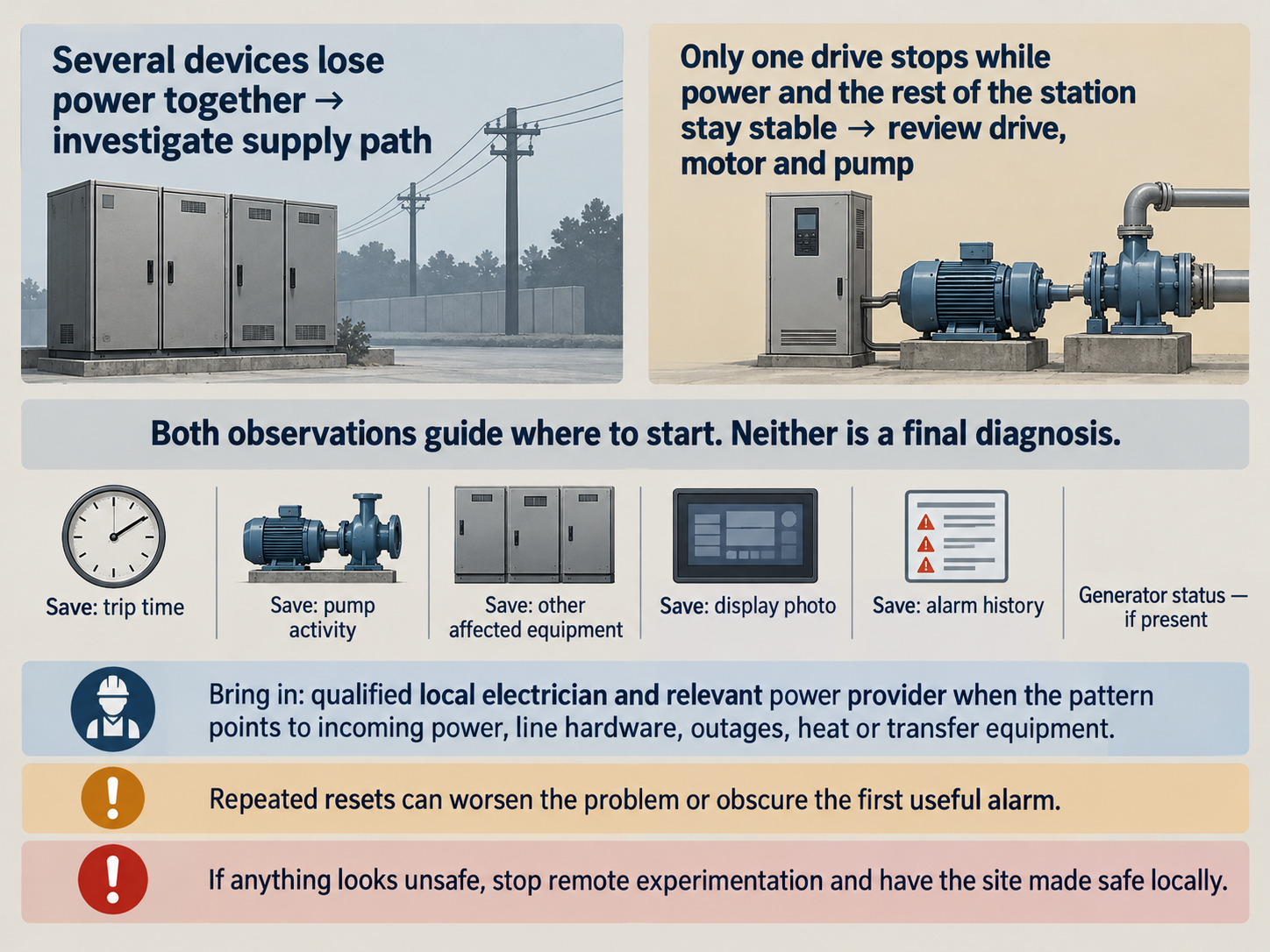
A fault code matters, but it is one line in the story. Ask the operator to note when each trip occurred, what the pump was doing, and whether lights, communications, or other motors were affected. Save a clear photo of the display and its alarm history if available. If the site has a generator, ask whether it was running or changing over at the time. Do not assume one exists at this particular station, or that a changeover caused the event.
Here’s a simple way to think about it. If several devices lost power together, investigate the supply path. If only one drive stopped while power and the rest of the station stayed stable, look more closely at that drive, its motor, and the pump. Neither observation is a final diagnosis. Both tell the local team where to start.
Ask for photographs of the drive and motor nameplates, the cabinet label, and any visible external damage that can be recorded safely. The site should never be asked to open live equipment or take electrical measurements just to satisfy a remote support call.
If possible, keep the very first alarm photo before anyone resets the unit. Ask whether the display went dark, stayed on with an alarm, or showed a warning only after power returned. Those three accounts lead to different follow-up questions. A dark screen alone does not identify a damaged drive; a continuing alarm does not prove an upstream fault either. A local qualified person can compare the power-provider report, site event log, and equipment history without asking the operator to guess from memory.
Bring in the right local person early
If the pattern points to incoming power, damaged line hardware, repeated outages, unusual heat, or a suspect transfer panel, a qualified local electrician and the relevant power provider should assess those parts under local safety rules. An overseas distributor can coordinate and document the case, but it cannot responsibly diagnose power quality from a photo alone.
The same applies if the drive itself may be damaged. A qualified person can check the installation, supply, motor, and protection history with proper access and instruments. Repeatedly resetting a drive without understanding the trip could make the situation worse or obscure the first useful alarm. If anything looks unsafe, stop remote experimentation and have the site made safe locally.
Baao Water District’s operations manual stresses recording equipment-status changes during handover. That is a helpful habit here: one shift’s account of “it tripped after the power came back” should not turn into the next shift’s “it simply failed.” The manual is not a drive-testing procedure for this case.
At handover, I would want the next operator to find one short note: which supply was in use, which devices stopped, the first alarm seen, what was reset, and who has been asked to inspect the electrical feed. It takes less effort than explaining the whole incident again during the next shift, and it protects the one clue that can disappear when alarms are cleared.
Put a small evidence packet beside the replacement request
Before approving freight, put these facts in one place. The aim is not paperwork for its own sake. It lets the site, distributor, and service team make the same decision from the same information.
Identity: drive and motor nameplates, station and cabinet IDs, and the installed application.
Timeline: trip times, alarm photos, outage reports, operator actions, and whether other equipment was affected.
Local findings: what the qualified electrician or power provider found, plus any unresolved safety concern.
Pump condition: whether the pump was meant to run, its water-source status, and what happened when service was restored.
Do not fill gaps with assumptions. The district’s infrastructure page mentions generator-supported infrastructure, but it does not establish that Agdangan had a generator during the reported pole work or that any generator caused a trip. Ask this station what equipment it actually has.
When would I approve the replacement?
If the local check finds a supply or connection problem, solve and monitor that first. If the supply is sound but the drive evidence points to an internal failure, a replacement review becomes reasonable. If the evidence still conflicts, explain exactly which observation is missing before shipping. A spare is valuable; it just should not be used as a guess.
BEDFORD’s after-sales support overview shows why clear equipment information and fault records matter in support conversations. For a suitable clean-water application, a water pump inverter is a possible product category, but no model can be chosen from the message “it trips.”
My reply to that urgent request would be: “We will help you restore service. First, let’s line up the trip times, supply events, alarms, and local electrical findings. Then we’ll know whether a new drive is the next move or a costly detour.”
In short, three routes remain: if several devices stopped together, investigate the supply path; if one drive alone stopped under stable site power, inspect that drive, motor, and pump; if the records cannot distinguish the two, ask for the missing evidence before shipping. The actual repair decision belongs to qualified people at the site. That may feel slower than dispatching a box, but it is the quickest way to avoid sending the wrong answer.
To provide the best experiences, we use technologies like cookies to store and/or access device information. Consenting to these technologies will allow us to process data such as browsing behavior or unique IDs on this site. Not consenting or withdrawing consent, may adversely affect certain features and functions.
Functional
Always active
The technical storage or access is strictly necessary for the legitimate purpose of enabling the use of a specific service explicitly requested by the subscriber or user, or for the sole purpose of carrying out the transmission of a communication over an electronic communications network.
Preferences
The technical storage or access is necessary for the legitimate purpose of storing preferences that are not requested by the subscriber or user.
Statistics
The technical storage or access that is used exclusively for statistical purposes.The technical storage or access that is used exclusively for anonymous statistical purposes. Without a subpoena, voluntary compliance on the part of your Internet Service Provider, or additional records from a third party, information stored or retrieved for this purpose alone cannot usually be used to identify you.
Marketing
The technical storage or access is required to create user profiles to send advertising, or to track the user on a website or across several websites for similar marketing purposes.