A motor nameplate photo is often the first thing a supplier receives. It tells you something useful about the motor, but almost nothing about the water. In Dak Mil, that gap matters most when an irrigation pump must keep working through a dry spell. Before you quote a drive, ask for a short record of the source level, the route to the fields, and what happens when several outlets are open.
You do not need to make the customer fill out a thick engineering report. A few dated readings, a marked sketch, and the pump maker’s chart are a good start. The point of asking for Dak Mil dry-season pump records is to find out what the pump must deliver on a difficult day, not just what its motor is rated to do.
Start with the water level, not the motor size
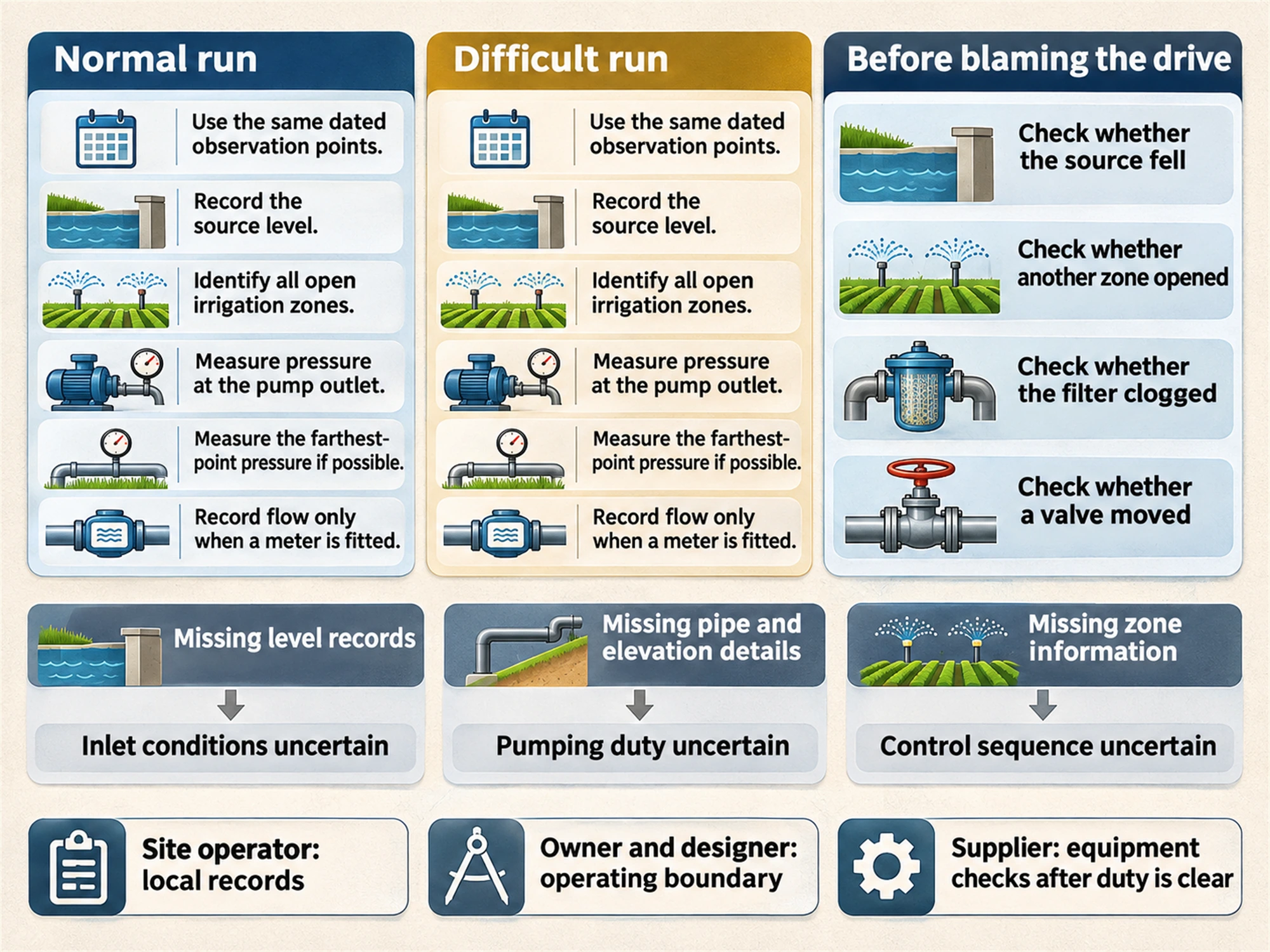
Ask the reservoir operator for the level readings they actually keep. A dated log is more useful than a sentence such as “the water is usually low in March.” It should show the measurement point and, if possible, the range seen across recent dry seasons. Ask whether the intake has ever been exposed, drawn air, or had to stop operating at a particular level. Those are questions for the site operator to answer from local records, not values a drive supplier should guess.
A falling source level can change the conditions at the pump inlet and the lift the pump must overcome. If the intake starts drawing air, turning up motor speed will not create water. Ask who decides when pumping must stop: the site operator, an agreed low-level signal, or another existing rule? The owner and designer need to set that boundary for this intake. A drive supplier should not guess it.
There is a local reason to ask. An April 2026 local government notice described scheduled releases from irrigation works in the area that includes Dak Mil. It said supply could be increased, reduced, or stopped according to water use and water actually available. That is a public water-management notice, not a reading from your customer’s intake or evidence of BEDFORD equipment. It reminds us to check the local operating schedule rather than assume the source stays constant.
Follow the route from the intake to the field
Once you have the source level, draw the water path in plain terms. Where is the intake? Where does the pump stand? Does it send water straight into distribution pipes, or first fill a higher tank? Where is the farthest field that still needs adequate flow? A simple marked sketch can settle misunderstandings that a long email does not.

Ask for the pipe sizes, approximate lengths, major valves, filters, and the elevation of any storage tank. If a designer has already calculated the pumping duty, request the calculation and the pump curve. The pump curve is the manufacturer’s chart showing how much water the pump can move at different pressures or lifts. A motor’s kilowatt rating does not give you that answer.
Take two common layouts. One pump may fill a nearby storage tank; another may feed the farthest field directly. They could have motors of the same size, yet face different water-delivery tasks. The U.S. Department of Energy’s pumping-system sourcebook explains how water level and the route through the system affect where a pump operates. You do not need to redo its calculations in an inquiry email, but you do need the site information those calculations depend on.

You may hear, “The old pump runs, so why do we need all this?” Because “runs” and “delivers enough water at the worst useful operating point” are different tests. A partially closed valve, a blocked filter, or a lower-than-expected reservoir level can change the result. A site reading taken while the system is working is far more helpful than choosing a larger inverter on instinct.
A quote should say when the pump curve or the site drawing is missing. That way the customer can see which parts are confirmed and which are still assumptions. A public regional irrigation notice cannot fill those gaps for a particular pump.
Ask when and how farmers use the water
A pump filling a storage tank has a different daily job from one feeding several irrigation zones directly. If there is a tank, ask when it is allowed to refill and what level controls the pump. If water goes straight to the fields, ask which zones can be open together and who changes them. A contractor may discover that “maximum demand” means three zones for one hour, not every outlet all day. Or it may discover the opposite.
Try to get a few real observations with dates and times: pressure while one zone runs, pressure when another opens, flow if it is measured, and whether the pump trips or loses prime during low-reservoir periods. Do not smooth these differences into one convenient number. The point is to see the conditions the equipment will actually face.
Keep one record from a normal run and another from a difficult one. For each, note where the water level was measured, which zones were open, the pump-outlet pressure, and the pressure at the farthest useful point if it can be measured. Record flow only if there is a meter. If pressure fell in the second run, do not immediately blame the drive: first check whether the source fell, another zone opened, the filter clogged, or a valve moved. The Hydraulic Institute’s explanation of variable-speed pumping makes the broader point that speed control has to be assessed against the system connected to the pump.
It also helps to ask what happens when the source is unavailable. Who decides to stop pumping? Is there a level switch, an operator call, or a written operating rule? A speed controller may work with an agreed signal or control arrangement if the selected equipment supports it, but the supplier must not invent a reservoir protection rule on the owner’s behalf.
Put missing information where everyone can see it
Sometimes the customer needs a budget figure before the records arrive. You can still be useful without pretending that the final design is settled. Send a short note with two parts: what has been confirmed and what remains open. For example, the motor nameplate and supply voltage may be known, while the lowest operating water level and the farthest-zone pressure are not.
Beside each open item, explain what decision it affects. Missing level records keep inlet conditions uncertain. Missing pipe and elevation details keep the pumping duty uncertain. Missing zone information keeps the control sequence uncertain. This gives the owner or contractor a practical collection list and protects everyone from treating a preliminary price as a promise of performance.
There is no need to invent a “safe” minimum reservoir level for Dak Mil. Only the local operator and qualified designer can set an operating boundary for a particular intake and pump. Another province’s figures are not a substitute for measurements at this site.
Then discuss the controller
Once the water path and operating range are reasonably clear, the pump supplier can check the pump curve, motor current, power supply, cable arrangement, and required controls. BEDFORD’s water pump inverter range is a category to consider for a suitable verified pumping duty. The existing pump inverter sizing guide explains why a motor’s power label alone is not enough. Neither page selects a model for this Dak Mil project.
Before requesting a firm quote, put four things in one email: a dated dry-season level log, a water-path sketch, the pump curve, and a note on which irrigation zones run together. If one is missing, name it and say what decision remains open. This gives the next person a usable record, and it turns “quote a drive for this motor” into a conversation about the water the pump must actually deliver.