

“The upper floors need more pressure. Can you quote a pump inverter?” That sounds like a straightforward request until you ask where the pressure was measured. A distributor may have the motor power and a photograph of the pump room, but no record of what happens at the affected taps during the morning rush. Without that record, a price is easy to give and hard to stand behind.
That is a common place for a Saudi high-rise domestic water booster quote to go wrong. The question sounds like it is about one electrical box. In reality, it is about getting usable water to the right places when demand changes. Before choosing a controller, you need to understand the building’s water path and the limits of the existing pump set.
Where does the water come from?
Ask someone to trace the water from its entry point to the fixtures. Does it enter a storage tank before the booster? Is there an intermediate tank or a roof tank? Which floors does each pump serve? A marked building drawing is ideal, but even a carefully annotated sketch is better than “it is a 20-story building.”

Why start here? Imagine the source tank is low during the morning rush. The upper-floor taps may slow down, yet a faster pump cannot supply water that is not available at its inlet. Or perhaps a valve has isolated part of the building. A drive setting will not reopen that valve. The water path tells you what problem you are actually trying to solve.
Keep this conversation about domestic water. Chilled-water circulation for air conditioning, wastewater lifting, and other building systems have different jobs. Combining them in one quotation because they all use pumps makes the scope harder to understand and easier to get wrong.
Which floors are struggling, and when?
“The top floor has low pressure” is a useful complaint, but it is not yet a measurement. Ask for the actual floor, the location of the tap or test point, the time of day, and a pressure reading if one can be taken. Ask for a reading near the lower end of the same pressure zone, too. If a building has several zones, do not assume that one sensor speaks for all of them.
Make the request easy for the building team: take one set of readings when residents report the problem, then repeat at a quiet time at the same two points. Note the source-tank level, which pumps were running, and where the pressure sensor is mounted. Leave the pressure fields blank until someone actually measures them; a made-up “typical” value would hide the very difference you need to find.
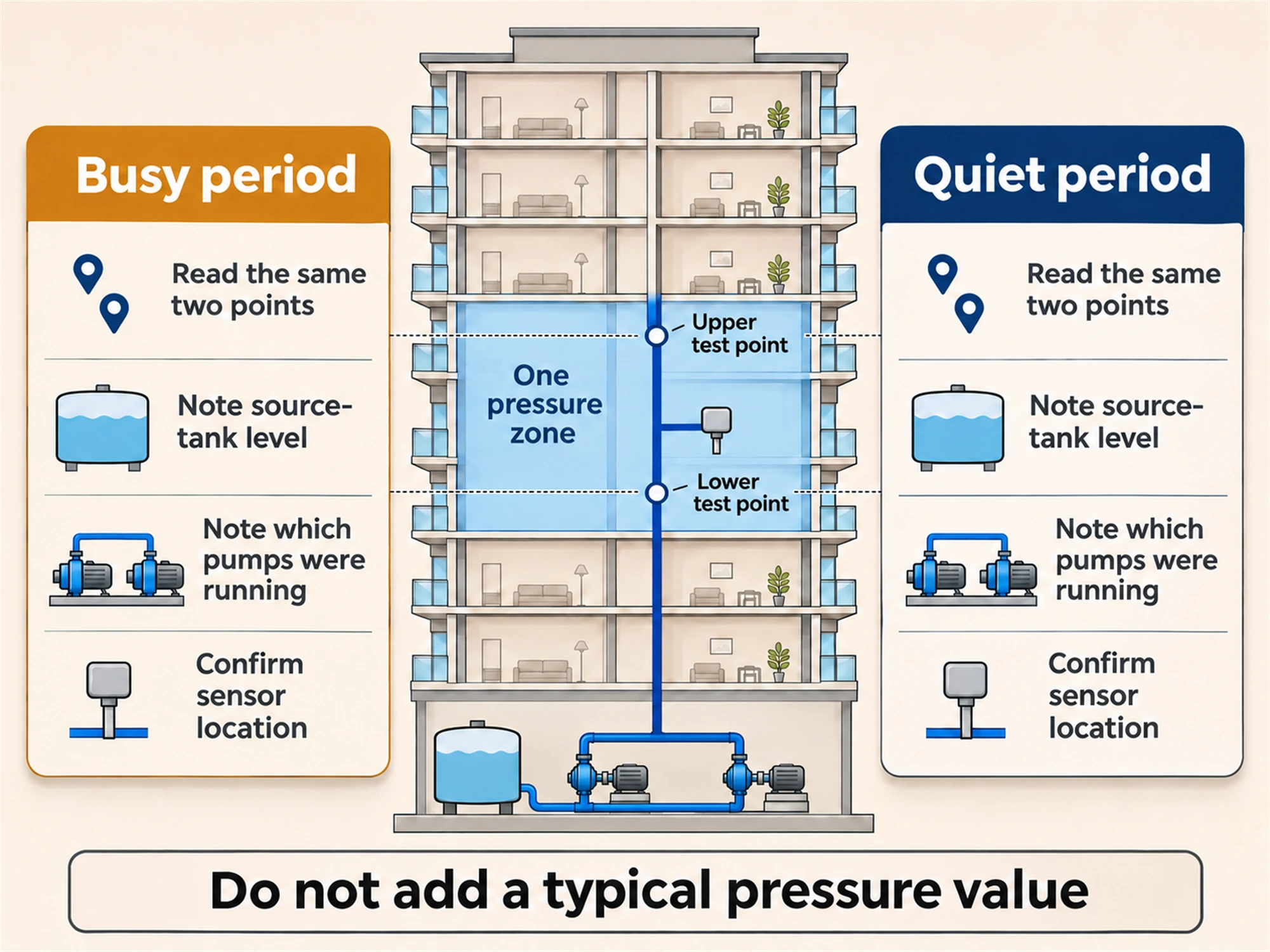
A pressure zone is simply the part of the building served together under one pressure arrangement. A tall building may divide floors so lower outlets are not exposed to the same conditions as upper ones. That arrangement matters more to a useful quote than the building’s total height by itself.
Then compare busy and quiet periods. Does the complaint happen only when many residents use water? Does the source tank level fall at the same time? Does the booster run continuously, or start and stop often? You do not need to guess a perfect pressure target on the first call. You need a few observations that show how the system behaves.
Consider two hypothetical buildings with the same motor rating. In one, the tank feeding the pump is nearly empty at peak demand. In the other, water is available, but the pressure sensor is on a different branch from the apartments reporting trouble. They may need different fixes, even though the nameplates look identical. That is why a price based only on kilowatts can be misleading.
What does the pump set have to do?
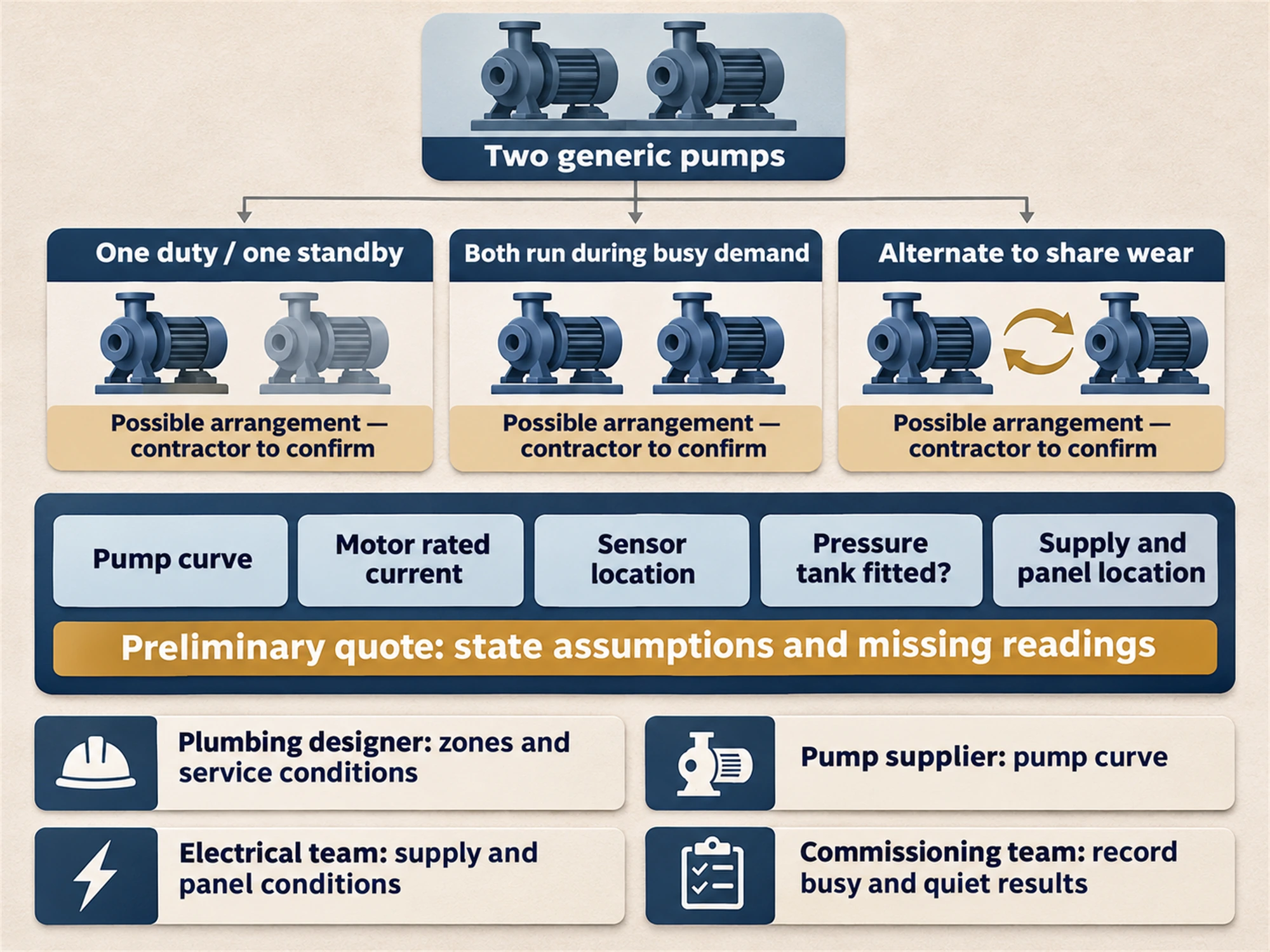
Once the water route and complaint are clear, ask the pump supplier for the pump curve and motor nameplate. The curve shows the pump’s expected flow at different pressures. The nameplate gives the motor’s electrical details, including rated current. You need both: the controller must suit the motor, while the pump itself must be capable of the water-delivery job.
Ask how many pumps are in the set and what each one is meant to do. “Two pumps” could mean one working and one on standby. It could mean both run together during a busy period. It could also mean they alternate so wear is shared. The contractor should say which arrangement the building expects, what happens if a pump stops, and how maintenance will be handled. Do not promise uninterrupted water service merely because a quotation mentions two pumps.
There are smaller details worth gathering now rather than after delivery: where the pressure sensor is installed, whether a pressure tank is fitted, what the electrical supply is, and where the control panel will sit. If the building uses a generator, the electrical team should explain how the booster is expected to operate when power changes. The final control response and safety arrangements belong in the approved project design and commissioning plan.
What does local compliance actually require?
Saudi Arabia’s plumbing-code framework is relevant to domestic water. The Saudi Building Code Council’s overview identifies SBC 701 with water supply and distribution. Its current code catalog lists the 2024 Saudi Plumbing Code. Those are starting points for a compliance discussion, not a substitute for the requirements applicable to this building.
Neither link hands you a pressure setpoint or certifies a product. Ask the project’s licensed designer, contractor, and responsible local authority which current provisions apply and who will verify the complete installation. A supplier should never present a general code listing as proof that a particular drive is “SBC-approved.”
Make the quote useful even when details are missing
You may still need to send a preliminary price. If so, write down the assumptions in language the customer can follow. What water source and tank level are assumed? Which pressure zone will the set serve? Which pump curve and motor-current values were used? How many pumps are expected to run, and what pressure readings are still missing?
Next, say who will check those open points. The plumbing designer may own the zones and required service conditions. The pump supplier can confirm the pump curve. The electrician can confirm supply and panel conditions. The commissioning team should record what happens at both busy and quiet times, and who accepts the result. This is not paperwork for its own sake; it helps keep a provisional equipment price from being mistaken for a complete water-system guarantee.
For a suitable, fully checked domestic-water booster, BEDFORD’s water pump inverter range may be a category to review. Its pump inverter sizing guide explains why motor power alone is not enough. Neither link chooses a model for this building, confirms Saudi code compliance, or replaces the project designer’s work.
Before the final quote, ask for a water-path sketch, busy- and quiet-time readings from the same pressure zone, and the pump curve. Note whether the source tank fell or a second pump started when the complaint occurred. If those facts point to a water-supply or piping problem, say so rather than selling a faster controller as the cure. “More pressure upstairs” becomes useful only when everyone can see which part of the system is falling short.