

You have two offers on your desk for a chilled-water pump drive in Dubai. One costs less. The other includes clearer commissioning support, spare-parts arrangements, and a named service contact. Which one should you recommend?
There is no honest answer until you know what the pump must keep running and what happens if it stops. In a Dubai district cooling pump tender, the drive is only one part of a system that moves chilled water between a central plant and the buildings it serves. The cheaper offer may be perfectly reasonable. Or it may leave the buyer paying later for work that nobody put in the first price.
First, locate the pump in the cooling system
District cooling is not just a large air conditioner. The International District Energy Association describes a central plant supplying chilled water to connected buildings through insulated pipes. DEWA’s 2025 energy-efficiency handbook also distinguishes the district network from heat exchangers and secondary pumps inside customer buildings. These sources explain the layout, not the duty of the particular pump in your tender.
So ask for a marked drawing. Is the pump moving water inside the plant, across the distribution network, or within one customer’s building? Which valves, tanks, heat exchangers, and other pumps affect its route? A quote for one building loop should not silently become a quote for a plant-wide network pump. Even if both use chilled water, the operating range and who controls the pump may be different.

Next, get the pump curve, motor nameplate, and a description of the operating points the owner expects. If the tender says “variable flow,” ask what changes the flow and how the pump will respond. The lowest sticker price is not a fair comparison if one bidder checked these conditions and another priced only from motor power.
Ask what a stopped pump would actually interrupt
Imagine a drive trips on a hot afternoon. Is there another pump ready to take over? Can the operator switch it manually? Would a single building notice, or could a larger loop be affected? Those are not questions a sales brochure can answer. They depend on the site’s hydraulic arrangement, controls, staffing, and operating plan.
Write down the expected response. Who receives the alarm? Who is allowed to restart equipment? Is someone on site after hours? Is a spare drive stored locally, or would a replacement have to be shipped? How quickly does the tender actually require the supplier to respond? If it does not say, ask the issuer. Do not infer a service-level agreement from words such as “reliable” or “critical.”
Do not use another operator’s overall availability figure as a stand-in for this pump’s uptime. It cannot tell you whether a spare pump is installed, whether a technician is on call, or what the bidder has actually promised. Put the required response and handover arrangements in writing for this tender instead.
Compare the two prices on the same job
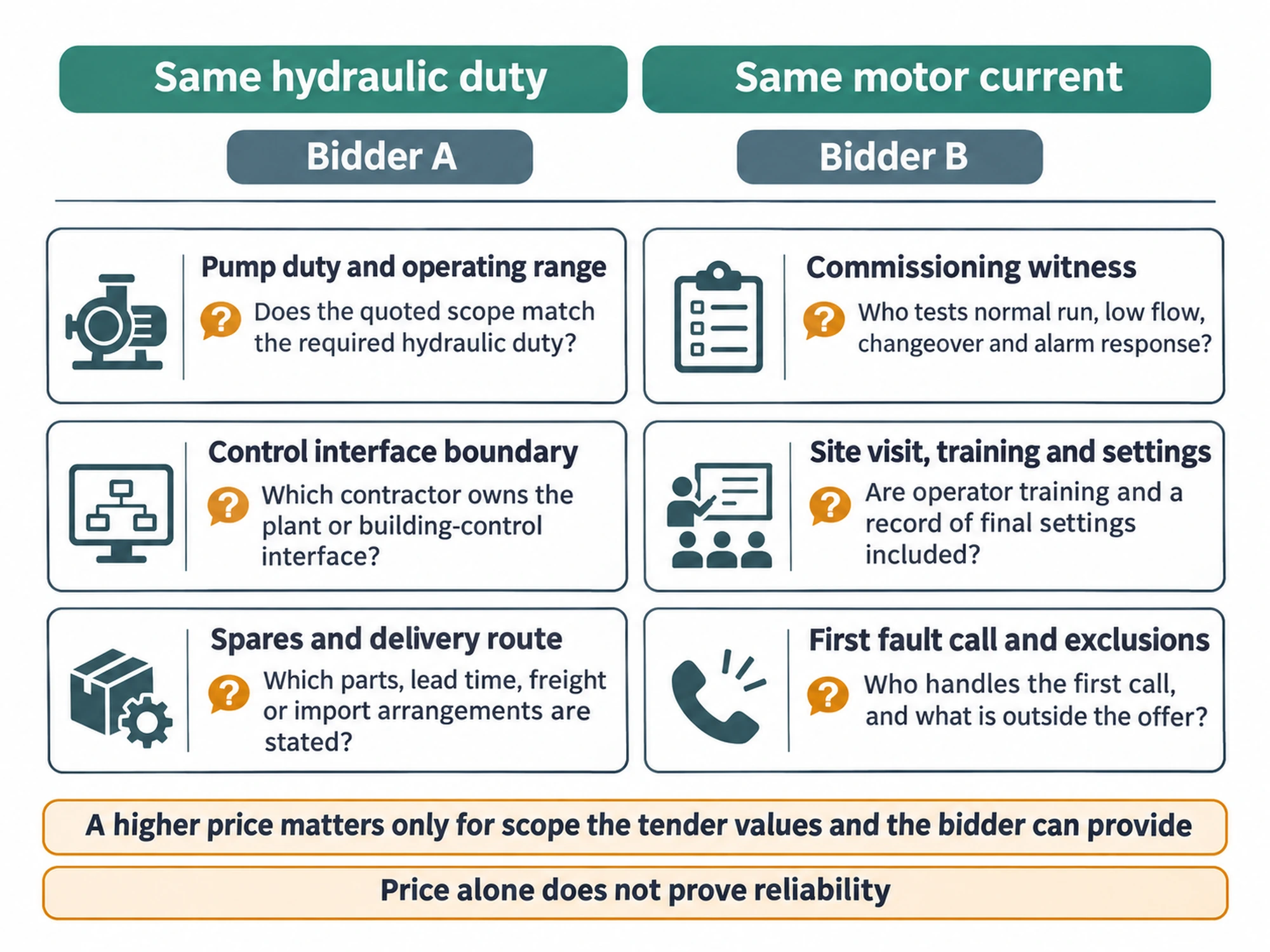
Here is a simple way to do it. Put the offers side by side and read beyond the equipment line. Does each cover the same pump duty and motor current? Does each say who will test normal running, low-flow operation, pump changeover, and alarm signals? Does either include a site visit, operator training, or a record of final settings? If the building-management or plant-control interface belongs to another contractor, is that boundary written down?
Give each bidder the same short comparison sheet. One row describes the pump and the required operating range. Another says what the bidder will deliver at commissioning. A third names spare parts, expected delivery time, and who handles the first fault call. Add a space for exclusions. If a response is blank, request clarification rather than awarding that row an imaginary value.
Then look at time and distance. A part can be inexpensive but slow to reach the site. A local service promise can sound attractive but mean little if no one has named the technician or the parts held nearby. Ask about lead times, freight, import arrangements, warranty conditions, and what happens when the cause of a failure is still unknown. The owner may prefer a lower first price with a separate spare strategy. That is a valid choice when it is deliberate.
Do not turn the comparison into “expensive means good.” It does not. A higher price only earns its place if it buys something the tender values and the bidder can actually provide. The point is to compare two complete offers for the same duty, not two totals hiding different assumptions.
Use real operating information for performance claims
Variable speed can help a pump respond to changing demand, but a sales percentage copied from another site tells you little about this loop. Ask the operator what is measured now: flow, pressure, running hours, pump status, motor current, and alarms. The U.S. Department of Energy’s MEASUR pumping assessment tools use field-measured data to examine pump systems and possible changes. That is the right discipline for judging a proposed operating improvement, even though the tool does not approve a Dubai tender.
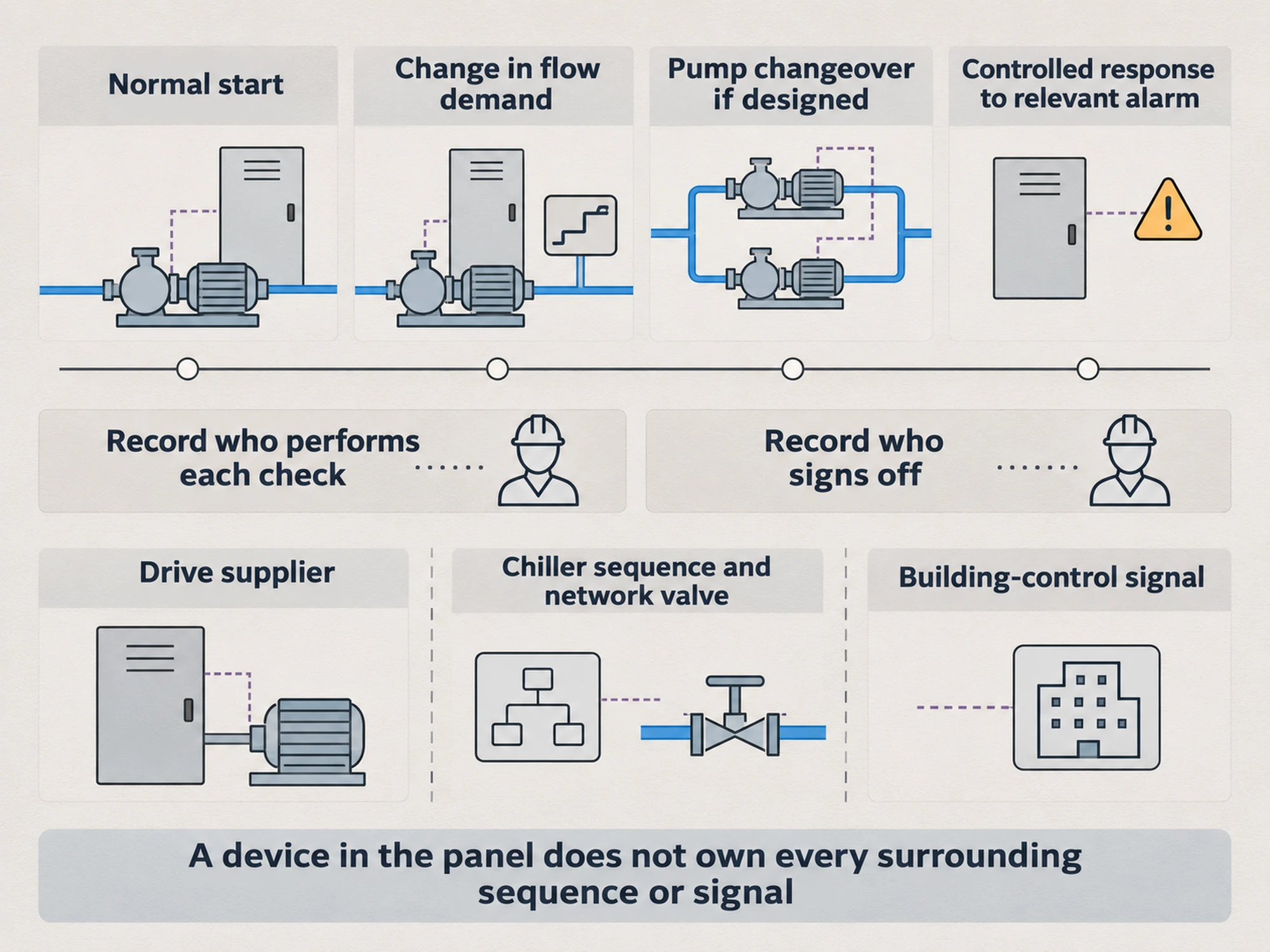
During commissioning, the team can agree on a few situations to witness: a normal start, a change in flow demand, a pump changeover if the design includes one, and a controlled response to a relevant alarm. Record who performs each check and who signs off. A drive supplier should not be held responsible for an unreviewed chiller sequence, network valve, or building-control signal simply because its device is in the panel.
Where does a BEDFORD offer fit?
Only after the pump duty, motor, control interface, environment, and service scope are known should a category be discussed. BEDFORD’s general-purpose VFD range or water pump inverter range may be considered for a compatible circulation duty, subject to the exact application review. Those links do not prove suitability for every district-cooling plant or promise a response time that has not been agreed.
Before you sign off on the lower offer, ask one final question: “If this pump stops tomorrow, what has each bidder actually promised to do?” When the answer is clear, the price difference becomes something the buyer can judge rather than a guess about reliability.